
Blog
Vendor Invoice Audit: How to Cross-Reference Hundreds of Invoices Against POs and Rate Cards
February 13, 2026


.svg)

The gap between the process you have and the coverage you need
Most AP teams have a vendor invoice audit process. Invoices get matched against purchase orders. Discrepancies get flagged. The obvious errors get caught.
The problem is coverage. With hundreds of invoices per cycle, each requiring a line-by-line comparison against the PO and the contract rate card, the realistic outcome is that high-dollar invoices get thorough review, mid-range invoices get spot-checked, and the long tail gets approved on pattern recognition. It looks about right. The vendor is familiar. The amount is in the expected range.
It is a capacity constraint. The team has two to three days between invoice receipt and payment run. The work is sequential, manual, and format-dependent. The coverage your team can achieve is bounded by the hours available.
The result is a gap between what the audit should catch and what it actually catches. That gap has a dollar value. Industry benchmarks consistently put invoice error rates at 5-15% of total volume, with duplicate payments alone accounting for 0.1-0.5% of disbursements.
What a thorough vendor invoice audit actually requires
A complete vendor invoice audit cross-references five dimensions across three source documents: the invoice, the purchase order, and the contract rate card. In practice, most teams prioritize the first two and defer the rest when time runs short.
1. Price verification against the rate card
Every invoiced unit price compared against the contracted rate. This catches vendor billing errors, unapplied contract pricing, and mid-contract rate changes that were not reflected in the invoice.
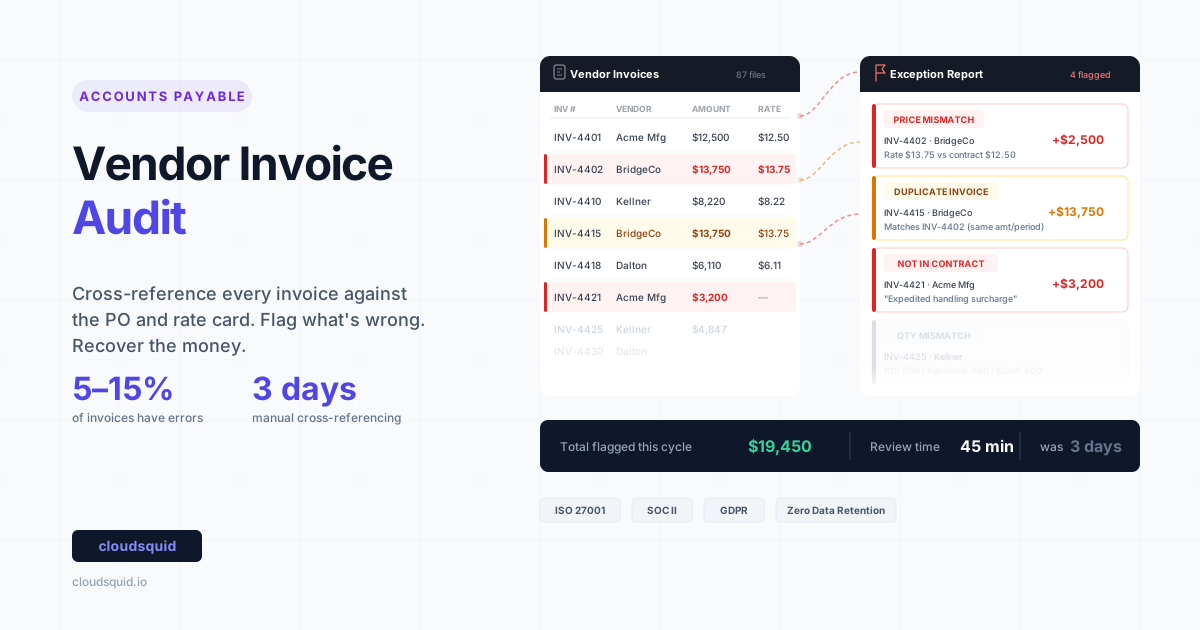
The impact scales quickly. A $1.25 per-unit discrepancy across 2,000 units is a $2,500 overpayment on a single invoice. Across a vendor portfolio with quarterly rate card updates, unverified pricing is one of the most common sources of AP leakage.
2. Quantity reconciliation across PO, receipt, and invoice
The three-way match: PO quantity, goods receipt quantity, and invoiced quantity must agree. A PO for 500 units with a receiving report of 480 and an invoice for 500 means payment for 20 units that never arrived.
This requires data from three systems (procurement, warehouse, and AP) which rarely share a common format or identifier.
3. Duplicate invoice detection
Same vendor, same amount, same service period, different invoice number. Vendors resubmit invoices for legitimate reasons (corrections, reissues after system changes) and the resubmission sometimes reaches AP alongside the original.
Duplicate payments cost organizations 0.1-0.5% of total disbursements. On $50 million in annual payables, that is $50,000 to $250,000. Detection requires cross-referencing the current batch against the full payment history, not just the current cycle.
4. Contract compliance: charges not in the agreement
Line items on the invoice that have no corresponding line in the contract or PO. A $3,200 "expedited handling surcharge" on an invoice when the contract defines standard, express, and white-glove handling but not "expedited."
These charges are common in service agreements with broad scope language. They are also the hardest to catch manually because verification requires reading the contract, not just comparing numbers.
5. Billing period and date validation
Services billed for dates outside the contract window, or for periods already invoiced. An invoice covering January for a contract that expired in December. An overlapping service period with a prior invoice that was already paid.
Wrong-period charges also create downstream problems at close. The expense lands in the wrong month, accruals do not tie out, and the accounting team absorbs the correction work.
Why coverage gaps persist
The issue is not that AP teams lack the skill to catch these exceptions. The issue is that thorough coverage across all five dimensions, for every invoice, every cycle, requires more hours than the team has between invoice receipt and payment run.
The practical tradeoffs are predictable:
- Rate card verification gets deferred. Comparing prices against POs is standard. Comparing prices against the original contract rate card, which may be a PDF from eighteen months ago, adds significant time per invoice and is often skipped for lower-dollar vendors.
- Duplicate detection is reactive. Most teams catch duplicates when something looks familiar, not through a systematic cross-reference against payment history. Duplicates from different billing periods or with modified invoice numbers pass through.
- Contract compliance is handled by exception. Unless a line item is obviously unusual, it gets approved. The contract is only pulled when something triggers suspicion, which means charges that are plausible but unauthorized go unquestioned.
- The long tail is under-audited. Invoices below a certain dollar threshold get less scrutiny. The assumption is that errors on small invoices are immaterial. Individually they are. In aggregate, they compound.
These are rational decisions given the constraints. The question is whether the constraints can change.
Shifting the team from building the audit to reviewing it
The majority of time in a vendor invoice audit is spent on assembly: extracting data from invoices in mixed formats, locating the corresponding PO and rate card, and performing the line-by-line comparison. The actual judgment work (evaluating ambiguous exceptions, deciding what to dispute, identifying patterns) is a fraction of the cycle.
The Agent handles the assembly. Upload the invoices (PDFs, Excels, scanned documents, mixed formats across vendors), the PO file, and the rate card. Describe what the audit should check:
"Cross-reference each invoice against the PO and the rate card. Flag price discrepancies, quantity mismatches, duplicate invoices, and any charges not in the agreement. Produce an exception report and draft dispute emails for the clear-cut discrepancies."
The output is an exception report: every flagged line item, categorized by exception type, with the specific discrepancy quantified (invoice rate vs. contract rate, the per-unit delta, the total dollar impact) and the source evidence cited. For unambiguous discrepancies, dispute emails are drafted with the invoice number, line item, contract reference, and calculated variance.
The team's role shifts from data assembly to exception review. The analyst still evaluates every flag. They still make the judgment call on the ambiguous cases. But the hours spent on extraction, matching, and comparison are recovered, and the coverage is complete. Every invoice, every line, every dimension. Every cycle.
No integrations required. The Agent works with the files the team already has: ERP exports, vendor portal downloads, scanned PDFs. No IT project, no API configuration, no implementation timeline.
What the numbers look like
A mid-size manufacturer with 15 regular vendors and roughly 200 invoices per month.
Before: The AP team spends two to three days per cycle on manual cross-referencing. Coverage is partial: thorough for the top five vendors by dollar value, spot-checked for the rest. The team catches an estimated 60-70% of exceptions. Price discrepancies under $500 are waved through. Duplicate detection relies on analyst memory. Rate card verification is deferred for most vendors.
After: The same 200 invoices, cross-referenced against POs and rate cards in full. Exception report surfaces 18 discrepancies across all five categories. Six dispute emails drafted. The team reviews and acts on the exception report in 45 minutes. Overpayment caught this cycle: $14,200.
The specifics vary by industry:
- In CPG, co-manufacturer invoices routinely carry 40+ line items, each tied to a different SKU and production run. Rate cards change quarterly. Full rate card verification on every line is not feasible manually, yet that is where a significant portion of billing errors hide.
- In manufacturing, raw material invoices often reference index-based pricing. The contract specifies "LME + $0.15/lb" but the invoice lists a flat rate. Verifying the index for the billing period against the invoiced rate is a step that rarely happens consistently.
- In retail, freight and logistics invoices include accessorial charges (liftgate, residential delivery, fuel surcharges) billed at "market rate" under contracts that only define base rates. Without systematic verification, the vendor sets the price.
Every match, flag, and source citation is documented. When external auditors review the vendor invoice audit process, the output is a structured exception report with full traceability.
The value is in acting on the exceptions
The value of a vendor invoice audit is in recovering overpayments before the wire goes out, identifying vendor billing patterns that need contract-level correction, and closing the books with confidence that payables are accurate.
Every hour the team spends assembling the audit is an hour not spent on the work that drives those outcomes. Shifting the team from assembly to review changes the economics of the process and closes the coverage gap that most AP teams have accepted as inevitable.