
Blog
Customer Price List Maintenance: Managing Cost Changes Across 20 Retailer Pricing Agreements
February 13, 2026


.svg)

The cost change ripple
A raw material cost increases by 8%. A co-manufacturer raises their conversion fee. A tariff takes effect on an imported component.
The immediate question is operational: which customer price lists are affected, by how much, and when do the new prices need to be in place? The second question is financial: does each updated price still hit the margin target for that customer, given their specific pricing structure?
For CPG and manufacturing companies selling into retail, the answer is rarely straightforward. Each retailer has a different pricing agreement. Some are list price minus a percentage discount. Some are cost plus a markup. Some have promotional pricing windows where the base price is overridden entirely. Some have annual price locks that prevent mid-year adjustments. Some have margin floors written into the agreement.
The pricing team maintains all of this in a spreadsheet. Often a large one, with a tab per retailer or a tab per product category, cross-referenced against a cost build-up sheet that feeds the calculations. When a cost input changes, someone has to trace the impact through every tab, recalculate every affected price, verify margin compliance for each customer, and produce an updated price list for each retailer in their required format.
With 20 retailers and hundreds of SKUs, that trace-through is a multi-day exercise. The risk is not that the team cannot do it. The risk is that the exercise takes long enough that price updates are delayed, margins erode for a cycle before corrections are implemented, or an update to one retailer's list introduces an inconsistency with another retailer's agreement.
What makes customer pricing complex
The complexity comes from the number of combinations and the variation in how each agreement is structured.
Pricing structure variation
A company with 20 retail customers might have five or six different pricing structures in play simultaneously:
- List minus discount. Retailer pays published list price minus a negotiated percentage. The discount may vary by product category, by volume tier, or by promotional period.
- Cost plus markup. Retailer pays a defined cost base plus a fixed or percentage markup. The cost base itself may be defined differently per agreement (raw material cost only, fully loaded cost, or a negotiated "cost" that is really a reference price).
- Fixed price with annual review. Retailer pays a locked price for 12 months. Adjustments happen at renewal. Mid-year cost changes are absorbed until the next review window.
- Tiered pricing. The unit price changes based on volume commitments. A cost increase may move margins below target at the lowest tier while remaining acceptable at the highest tier.
- Promotional pricing. Temporary price overrides during defined windows. A cost change during a promotional period may not be reflected in the promotional price, creating a margin gap that only becomes visible when promotional and regular pricing are compared side by side.
Each structure requires a different calculation path. A 4% cost increase translates to different price adjustments depending on which structure governs that customer.
The margin verification layer
Updating the price is only half the work. The other half is verifying that the updated price meets margin requirements. Margin targets vary by customer, by product category, and sometimes by channel (warehouse club vs. grocery vs. e-commerce). Some agreements include minimum margin clauses. Some have most-favored-nation provisions that link one customer's pricing to another's.
A cost increase of 4% on a product with a 32% target margin requires a different price adjustment than the same increase on a product with a 22% target margin. If the first product is sold to Retailer A on a cost-plus basis and Retailer B on a list-minus-discount basis, the math is different for each.
Format and timing requirements
Each retailer expects price updates in a specific format. Some accept a spreadsheet. Some require upload to a vendor portal. Some want an EDI 832 price/sales catalog transaction. The effective dates may differ: one retailer requires 60 days' notice, another requires 90, a third allows updates on the first of any month.
A single cost change event generates a different deliverable for each affected retailer, with different calculations, different formats, and different implementation timelines.
Where the process breaks down
The pricing spreadsheet works as a calculation tool. Where it breaks down is as a management tool, particularly when cost changes are frequent, the retailer portfolio is growing, or the pricing team is handling multiple cost change events in overlapping windows.
Tracing impact across agreements takes too long. A cost input change requires identifying every SKU that uses that input, then identifying every retailer agreement that covers those SKUs, then recalculating the price under each agreement's specific structure. In a spreadsheet with 15 tabs and hundreds of rows per tab, this trace-through is manual and sequential. One cost change event can consume two to three days of a pricing analyst's time.
Margin verification is inconsistent. Checking that every updated price meets the margin target for that customer and product combination requires a second pass through the same data. When the team is under time pressure to deliver price updates before a retailer's notice deadline, margin verification gets abbreviated. The prices go out, and margin analysis happens after the fact.
Cross-customer consistency is hard to maintain. A most-favored-nation clause in Retailer C's agreement means their price cannot exceed Retailer D's price for the same product. When both prices are being updated simultaneously from a cost change, the interdependency is easy to miss in a tab-per-retailer spreadsheet.
Version control is fragile. The pricing spreadsheet is the single source of truth. When two cost changes overlap (raw material increase in week one, freight surcharge in week three), the second change needs to build on the first. If someone is working from a stale version, or if the first change has not been fully propagated before the second one begins, the compounding errors are difficult to detect.
The knowledge is concentrated. The pricing analyst who built the spreadsheet understands the formulas, the exceptions, the retailer-specific quirks (Retailer F rounds to the nearest nickel, Retailer G requires prices ending in .99, Retailer H has a different discount for their organic line). When that person is unavailable, the rest of the team works from the spreadsheet without the context that makes it reliable.
From tracing the impact to reviewing the recommendations
The time-consuming portion of customer price list maintenance is the trace-through: identifying which SKUs are affected by a cost change, recalculating prices under each retailer's agreement structure, verifying margins, and flagging inconsistencies. The valuable portion is the decision-making: which prices to adjust, by how much, and when to implement.
The Agent handles the trace-through. Upload the pricing spreadsheet (all tabs), the cost build-up sheet with the updated inputs, and the relevant retailer agreements. Describe what the analysis should produce:
"A cost input has changed. Identify every SKU affected. Recalculate the customer price for each affected SKU under each retailer's pricing agreement. Flag any updated price that falls below the margin target. Flag any cross-customer inconsistencies, including most-favored-nation violations. Produce an updated price list per retailer in their required format."
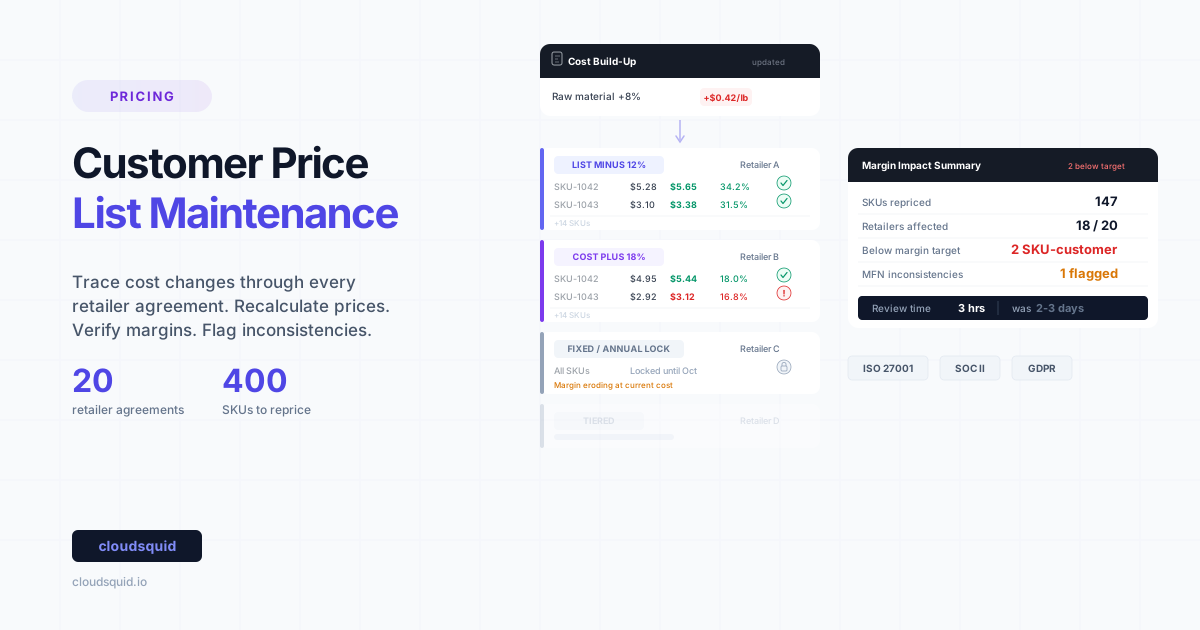
The output is a set of updated price lists, one per retailer, with every affected SKU recalculated under that retailer's specific pricing structure. Alongside the price lists, a margin impact summary flags every customer-SKU combination where the updated price falls below target margin, with the specific shortfall quantified. Cross-customer inconsistencies are flagged with the relevant contract clause cited.
The pricing team reviews the recommendations, makes judgment calls on the margin exceptions (absorb the shortfall, request a price increase, renegotiate the agreement), and approves the updated lists for distribution.
The Agent works with the files the team already has: the pricing spreadsheet, cost sheets, and agreement documents. No ERP integration or pricing software implementation required to start.
What the numbers look like
A mid-size CPG company with 20 retail customers, 400 SKUs, and quarterly cost reviews.
Before: Each cost change event takes the pricing team two to three days to trace through all agreements and produce updated price lists. Margin verification adds another half day. Cross-customer consistency checks happen ad hoc. The team processes four to six cost change events per year, consuming roughly 15 to 20 working days annually on price list maintenance alone. Price update delays average two weeks past the optimal implementation date, resulting in one to two cycles of margin erosion per event.
After: The same cost change, traced through all 20 retailer agreements in full. Updated price lists produced per retailer. Margin impact summary flags 12 SKU-customer combinations below target. Two most-favored-nation inconsistencies identified. The pricing team reviews and finalizes in three hours. Price updates reach retailers within the notice window. Margin erosion from delayed implementation is eliminated.
The specifics shift by industry context:
- In CPG, promotional pricing calendars add a layer of complexity. A cost change that takes effect mid-promotion requires two calculations: the impact on the regular price and the impact on the promotional price. If the promotional price is fixed, the margin during the promotional window may drop below the floor, which needs to be flagged before the promotion launches.
- In manufacturing, customer pricing often involves configured or make-to-order products where the cost build-up itself is complex (raw materials, conversion, freight, packaging). A change in one input may affect some configurations but not others, and the pricing impact depends on the bill of materials for each configuration.
- In food and beverage, commodity input costs (dairy, grain, oils) fluctuate frequently. Companies with index-based pricing agreements need to recalculate monthly, while those with fixed-price agreements absorb volatility until the next review window. Managing both types simultaneously across a retailer portfolio compounds the reconciliation work.
Every calculation, margin check, and cross-customer comparison is documented. When the sales team asks why Retailer A's price increased by 3.2% while Retailer B's increased by 4.1%, the answer is traceable to the specific agreement structure and cost build-up for each.
The margin risk is in the delay
Customer price list maintenance is often treated as an administrative task. In practice, it is a margin management function. Every day between a cost increase and the corresponding price adjustment is a day of margin erosion. Every retailer agreement that is updated inconsistently is a compliance risk. Every margin exception that goes undetected is revenue left behind.
The constraint has been the time required to trace a cost change through every agreement, verify every margin, and produce every deliverable. Removing that constraint turns price list maintenance from a multi-day reactive exercise into a same-day review.